Current topics
Globally
Three decades of InnoTrans – Interview
Interview mit Kerstin Schulz, Direktorin der InnoTrans
30 years of InnoTrans – what does this anniversary mean to you?
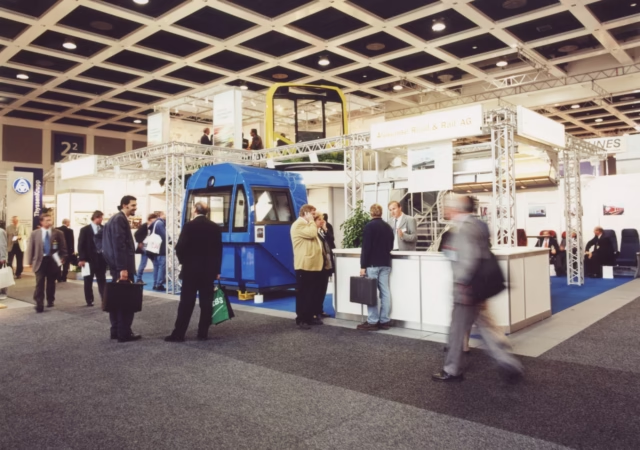
This year is a very special one for all of us at Messe Berlin and, of course, for me personally as well. A trade fair that has developed over 30 years into what InnoTrans is today is truly exceptional and makes us all very proud. I am always amazed when I place photos from 1996 next to those of today.
«I am always amazed when I place photos from 1996 next to those of today.»
Why?
Before the first InnoTrans, no one really knew what it would become. It was more of a gut feeling than a hard calculation that tipped the scales. In the end, we had 172 exhibitors on our grounds and at the Wilmersdorf freight yard – at that time, there were not even any tracks on the exhibition grounds. Today, we have around 3,000 exhibitors from more than 50 countries. And the 6,300 visitors in 1996 have grown to nearly 170,000. We have become increasingly international; more than half of our visitors and exhibitors now come from abroad. That, too, was very different 30 years ago. We have always tried to keep up with the times. This year, for the first time, a hackathon will take place, we are awarding prizes to influencers, and we are offering guided tours on AI and robotics. We have completely redesigned our app for InnoTrans 2026, making the important so-called “matchmaking” even easier.
InnoTrans has always been fully booked far in advance. What do you attribute this to?
The portfolio of our exhibitors ranges from screws to larger individual components and complete vehicles. At InnoTrans, our visitors and exhibitors get a concentrated overview of what they would otherwise need to visit several trade fairs to see. This is also reflected in our exhibitor and visitor surveys: satisfaction levels are well above 90 percent across all areas. Once you have been to InnoTrans, you usually come back.
«The trend towards greater internationalisation will continue.»
Are there regions or segments that are currently gaining particular importance?
For more than 20 years, InnoTrans has been based on the segments Railway Technology, Public Transport, Infrastructure, Interiors and Tunnel Construction. This is essentially the backbone of InnoTrans. Currently, we are seeing a significantly increasing demand for infrastructure topics. From a regional perspective, we are seeing the strongest growth overseas: we are currently receiving particularly high demand from China and India. We have large delegations from the USA that have registered. South Americans are also becoming increasingly prominent. The trend towards greater internationalisation will continue.
Swissrail has been part of this internationalisation for many years.
Yes, and we are very pleased about that. At the premiere in 1996, two Swiss companies participated; in 2024, there were more than 130. We work together in a very trusting manner and have been able to realise many great projects together. The CO2-conscious Swissrail stand at the last two editions of InnoTrans has not only set standards but has also reflected a significant development in the industry. Almost every innovation presented at InnoTrans contributes to ecological sustainability. It also fits that many colleagues from Switzerland travel to Berlin in an environmentally friendly way by train instead of by plane. That makes me happy every time.
In 2027, InnoTrans Asia will take place for the first time in Singapore. Isn’t that competition for Berlin?
No, it is a complement, not a competitor. InnoTrans in Berlin remains the central meeting point of the industry and its core. InnoTrans Asia, on the other hand, is specifically aimed at the growth market in the Asia-Pacific region. There, demand for modern rail technology, automation and sustainable solutions is growing rapidly. We are now creating an attractive platform on site that is intended to provide access to this highly fragmented market. Not least, InnoTrans Asia is an important part of Messe Berlin’s internationalisation strategy. We have had very good experiences with the creation of such satellite formats with other events like ITB. Regional events such as ITB India, ITB China or, in the future, ITB Mexico benefit from the experience and network of the global flagship trade fair in Berlin. In turn, this flagship event is closer to the respective markets. The events thus reinforce each other.
«In the end, the success of a trade fair is always determined by the satisfaction of exhibitors and visitors.»
We are living in geopolitically very uncertain times. What role will centralised trade fairs play in the future?
The industry has been discussing this for decades: do we need large flagship trade fairs, or do smaller specialised events make more sense? I believe both formats have their justification. What matters is relevance. In the end, the success of a trade fair is always determined by the satisfaction of exhibitors and visitors. And with InnoTrans, we want to continue setting standards in the future.
Thank you very much for the interview!
Read the full edition of express here.
Note on the translation: this text was translated using AI and checked by us. If you find any mistakes or something that is not clear, please let us know.
More topics
Discover interesting topics
Focus on Infrastructure 2026
learn more
- Infrastructure
- Nationally
30 years InnoTrans – Swissrail still right in the middle
learn more
- Globally
Railway technology from 1990 to today – Switzerland as a driver of digitalization
learn more
- Safety & automation
- Nationally