Current topics
Safety & automation
Nationally
Railway technology from 1990 to today – Switzerland as a driver of digitalization
A personal assessment
Railway technology evolves over long periods of time. Changes rarely occur abruptly; instead, they tend to happen gradually—driven by technological progress, operational experience, and strategic decisions. Over more than thirty years working in signalling technology, I have had the privilege of witnessing this evolution first-hand.
In the 1990s, the focus was initially on the introduction of electronic interlockings. In 1997, we commissioned the first electronic interlocking in Switzerland—today, more than 100 Elektra interlockings are in operation nationwide.
Shortly thereafter, ETCS Level 2 marked the next major step. The pilot project Zofingen–Sempach still required a strong pioneering spirit, particularly in defining the interface between the interlocking and the RBC. On the new line Mattstetten–Rothrist, ETCS was initially introduced alongside conventional lineside signals.
At the same time, the introduction of European CENELEC standards fundamentally transformed the development of safety-critical systems. Harmonised certification processes improved quality and transparency, but also made projects more complex, longer, and in some cases more costly. In Switzerland, however, this transition was managed constructively through close collaboration between infrastructure managers, industry, and especially the Federal Office of Transport. The partnership-based role of the FOT was a key success factor.
With the NEAT projects, a new era began. The consistent decision to dispense with lineside signals in the base tunnels was bold and forward-looking. Today, Switzerland is internationally regarded as a benchmark for operating high-performance infrastructure with ETCS Level 2.
The next stage is now underway: the digitalisation of the interlocking landscape. With the EESA tender, SBB has taken an important and well-founded strategic step. It lays the foundation for a new generation of digital signalling systems and ensures the long-term development of railway infrastructure.
For me personally, this brings a cycle to a close. It has been a privilege to actively contribute to this development over many years, together with dedicated colleagues and forward-thinking customers. The foundations for the future are in place—and I am confident that the next generation will continue the successful path of Swiss railway technology with the same determination.
Written by Kurt Sauerwein
Former Swissrail board member, specialist area: signalling and automation
Read the full edition of express here.
Note on the translation: this text was translated using AI and checked by us. If you find any mistakes or something that is not clear, please let us know.
More topics
Discover interesting topics
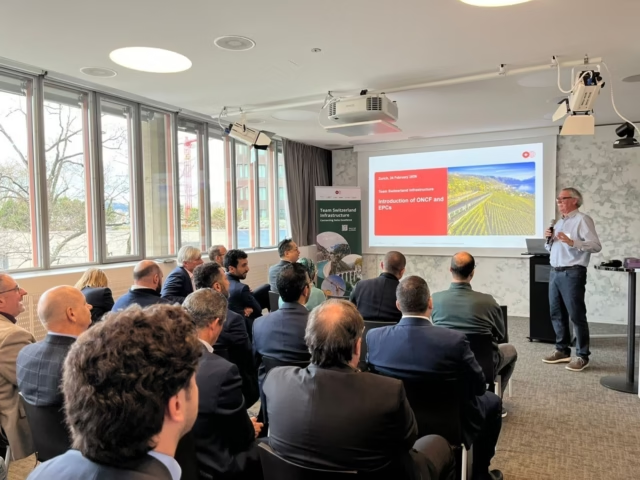
EPC Networking Day II – A successful relaunch
learn more
- Globally
The future of construction and mobility is shaped through collaboration – Interview
learn more
- Nationally
More dialogue, more impact: Two new Swissrail formats for a strong rail sector
learn more
- Nationally
- Sustainable mobility & digitisation